proximal and economic outcomes
Kabakoo estimates $6.30 in learner benefits per $1 over three years
Kabakoo estimates $6.30 in economic benefits for learners per $1 of program cost over three years. Its evaluation framework was designed with Paderborn University researchers; the longer follow-up was analyzed in-house, while the working paper found no clear short-term income effect.
Three-year benefits and income beyond the program
Kabakoo estimates $6.30 in economic benefits for learners per $1 of program cost over three years, or $8.40 including spillovers. Its income and economic mobility evidence sets out the assumptions used for that estimate.
The calculation uses a total cost of $226 per learner, counts 50% of the difference in self-reported income and applies a 10% annual discount rate.
Among people outside the program, those with passive exposure earned 26,700 FCFA (about $43) more in the prior month than those with no exposure. Those with active exposure earned 47,800 FCFA (about $78) more and were 18.6 percentage points more likely to report earnings as an employee.
A research partnership with distinct analytical roles
Kabakoo designed its evaluation framework with Martin Schneider and colleagues at Paderborn University. It analyzed the longer follow-up in-house, while Jamie Walsh at The Agency Fund ran separate analyses on the data.
The 2022 trial’s study abstract was published in the Academy of Management Proceedings in July 2023 (Islam, Herdejürgen, Kemayou, Kabst & Schneider). The Paderborn University working paper was published in February 2026 (Herdejürgen, Islam & Schneider).
Why the trial used quasi-experimental analysis
The trial began with random assignment of 327 eligible applicants. Training ran for six months starting in February 2022, followed by a survey six months after training. At that follow-up, the growth mindset comparison included 40 participants and 76 controls.
Some applicants joined the training group from the comparison group after others dropped out before training began. Because of that change, researchers used a quasi-experimental analysis rather than treating the final comparison as an unchanged randomized assignment.
Higher mindset scores, no clear early income effect
The working paper reports higher growth mindset scores for participants six months after training (p=0.0349). It found no clear short-term income effect. The 32-month follow-up reports later income outcomes.
These are different measures at different follow-up points. The reported mindset result is not presented as evidence that a change in mindset caused the later income outcomes.
Separate cohorts, longer follow-up horizons
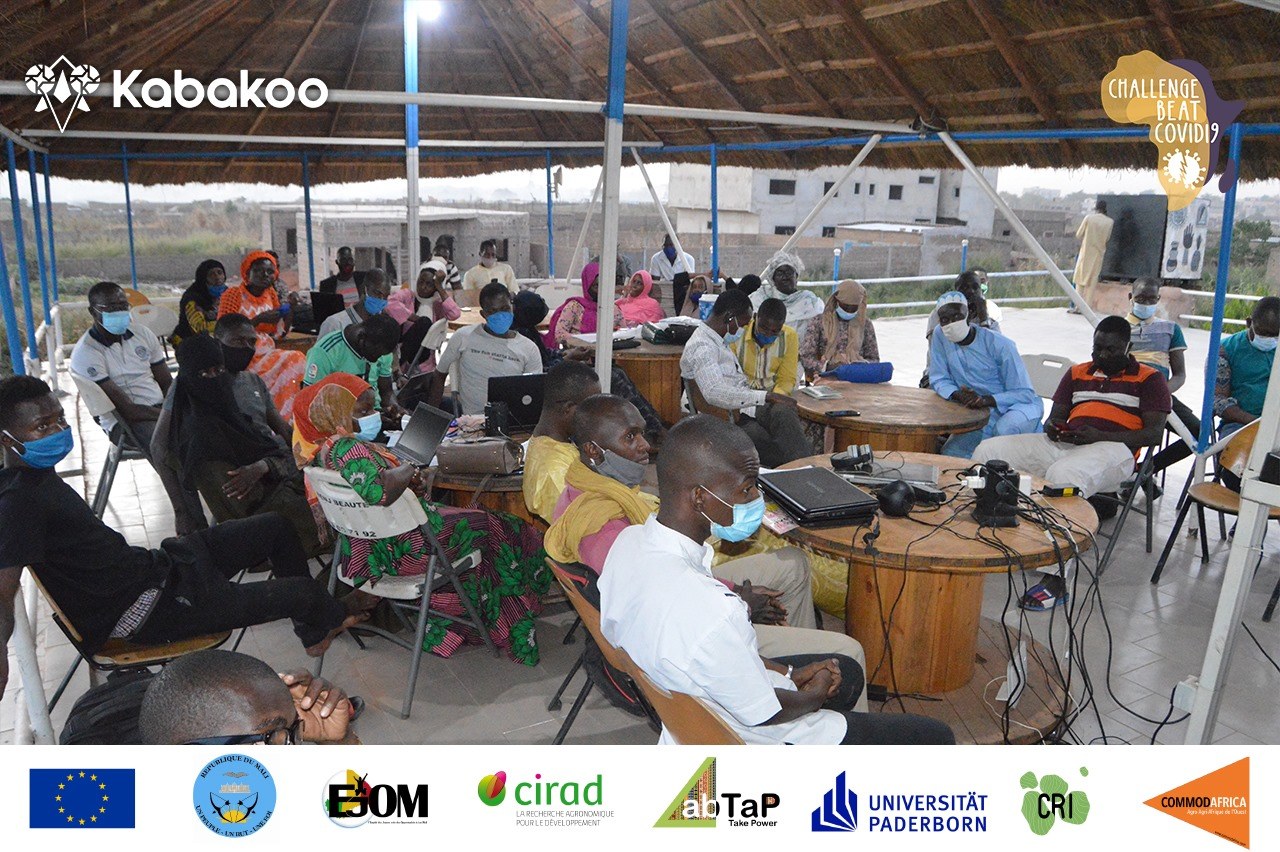
A separate four-year BEAT Covid-19 follow-up involved 29 participants from the 2020 EU/EJOM-funded program, funded via the EU Delegation to Mali. Reported in May 2025, it found a 4.9x ROI and that 83.4% of alumni earn over 150,000 FCFA/month, versus 30% in the comparison group.
Digital Makers Cohort 3 offers a twelve-month comparison: its longitudinal sample of 80 included 36 participants and 44 controls. Employment was 66.7% among participants versus 52.3% among controls; the Kabakoo Behavioral Index was 4.19 versus 3.80. NPS rose after the program ended, from 58 to 75 in this cohort, compared with 70 to 81 in earlier cohorts.